
Testimonial:
Augmenting a Friable Internal Obturator Muscle During Perineal Herniorrhaphy (Dr. Lara Dempsey, BVetMed, DipECVS, MRCVS)
A Europe and RCVS Specialist in Small Animal Surgery on the moment a routine repair needed backup she hadn’t planned on.
The Case:
A sticky situation where fatty tissue created less than optimal conditions for a perineal hernia repair, and how she repaired it with SIS+ biologic graft material.
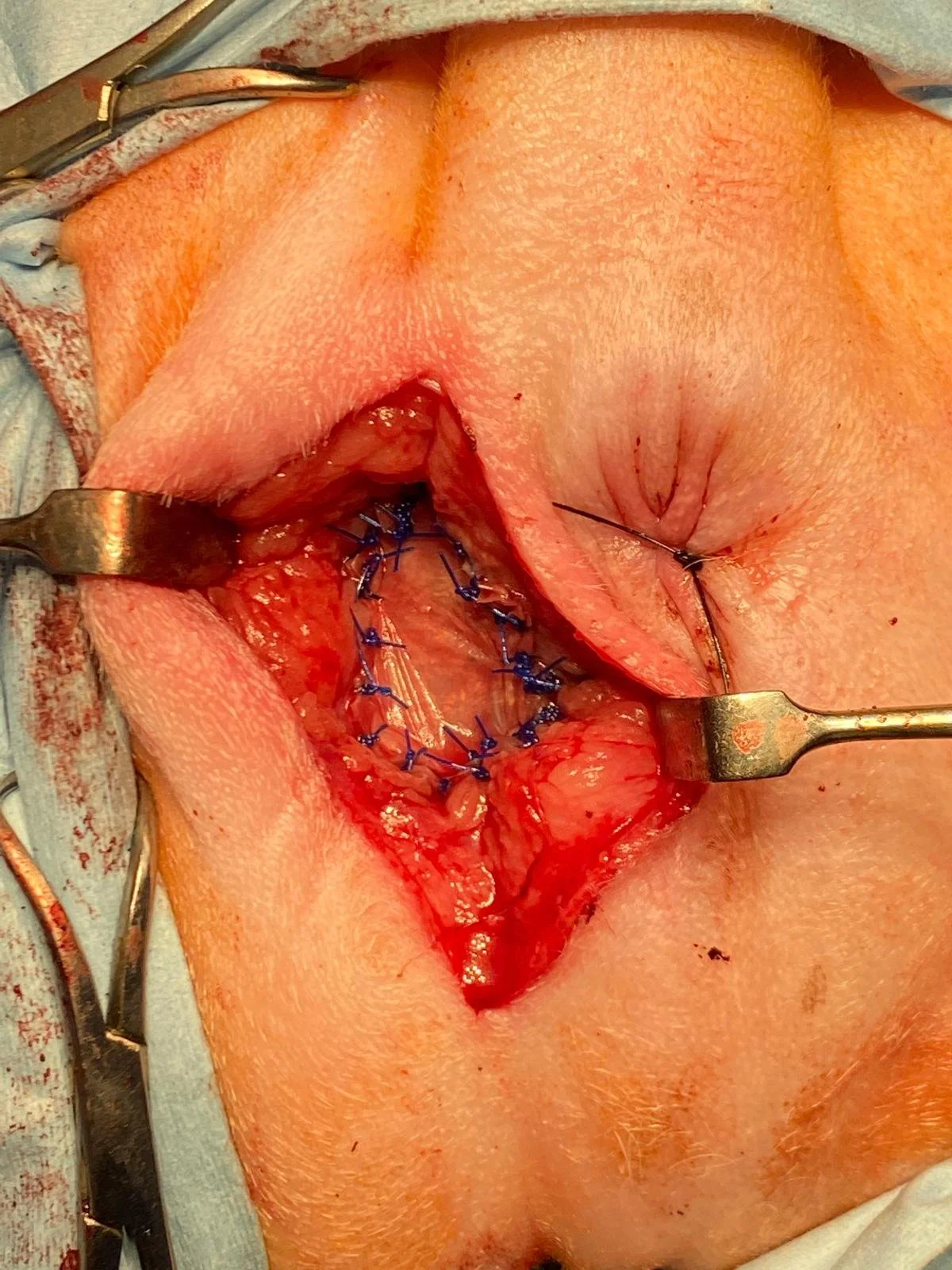
SIS+ multi laminate biologic graft used to augment the internal obturator muscle during perineal herniorrhaphy, shown in place
The Story:
Perineal hernia repair has one specific way of going sideways. You go in expecting an internal obturator muscle that can hold a suture, and sometimes what you find instead is tissue compromised by fat infiltration, thin and friable, not the foundation you were counting on.
That's what Dr. Lara Dempsey, BVetMed, DipECVS, MRCVS, ran into during a recent perineal herniorrhaphy. Dr. Dempsey is a European and RCVS Specialist in Small Animal Surgery and Head of Soft Tissue Surgery at Blaise Veterinary Referral Hospital, part of IVC Evidensia Referrals UK & IE.
Here's how she described it:
"At Blaise, we always keep a supply of multi laminate porcine SIS. We use it to augment tissues in hernias and defects and with oesophageal wounds. In the case pictured, it was used to augment the internal obturator muscle for perineal herniorrhaphy. The internal obturator muscle was friable due to a high content of fatty tissue. The porcine SIS worked really well and got me out of a sticky situation I wasn't anticipating."
Why this matters beyond one case
Dr Dempsey’s team keeps SIS+ in stock at all times, not because every case calls for it, but because they can't always predict beforehand which one will. A lot of soft tissue surgery works this way. The need for reinforcement becomes apparent once you're already in the surgical field, and that's a difficult moment to be without options.
The research said this would happen
A 2002 study on SIS in perineal herniorrhaphy in dogs, published in Veterinary Surgery, found that SIS performs well as a primary repair technique and specifically noted its clinical value "as augmentation when the internal obturator muscle is thin and friable, or as a salvage procedure in cases of recurrence." That's not a loose parallel. That's the exact scenario Dr Dempsey described, more than two decades after the research was published, holding up in a live surgical field at a referral hospital.
The takeaway for general practice
If perineal hernias don't land on your table often, it's easy to assume SIS+ belongs to specialty surgery. But the same logic that has Blaise keeping a supply on hand applies just as much at the general practice level. You don't always know you'll need backup tissue until you're already mid-procedure, and that's not a moment to improvise.