RediHeal Dental
Predictable healing for any extraction (yes, even that one).
What if routine extractions stayed routine... and the cases that keep you up at night became manageable?
You know those extractions that keep you up at night? The fractured carnassial in the geriatric dog. The full-mouth extraction in the stomatitis cat. The oronasal fistula repair that absolutely cannot fail.
What if those cases became... just another Tuesday?
RediHeal Dental is a ready-to-use, bone-healing biological fiber engineered to speed up healing and recovery after extractions. Made from borate-based, bioactive trace elements (not antibiotics or steroids), it actively promotes fast tissue regeneration, gently fills the void left after an extraction, and reduces complications like fistulas or delayed healing.
And the best part? Brand-new testing confirms RediHeal eliminates 99.99% of the bacteria that matter most in veterinary dentistry.
Why This Works (And Why You'll Actually Use It)
It kills the bacteria that matter. Independent lab testing confirmed RediHeal eliminates 99.99% of Porphyromonas gulae (the pathogen driving canine periodontal disease) and Streptococcus oralis (the biofilm-forming opportunist). This antimicrobial activity happens naturally through the material's ion release and pH modulation—no antibiotics, no steroids, just borate bioactive glass doing what it's chemically designed to do at the cellular level.
First, it creates an instant healing scaffold. The moment RediHeal hits tissue fluids, it forms a fibrin-like scaffold that gives healing tissue something to grab onto from day one. This prevents socket collapse, maintains space for bone regeneration, and organizes the wound bed so everything heals in the right place.
Then blood vessels show up - early and often. Here's where it gets interesting: as the borate fibers dissolve, they release boron and calcium ions that upregulate VEGF (vascular endothelial growth factor) and HIF-1α expression. Translation? Your patient's body gets the signal to build new blood vessels immediately. More blood vessels = more oxygen, faster healing, better wound closure. Your extraction sites fill with richly vascularized, actively healing tissue instead of just passively granulating and hoping for the best.
Bone regeneration happens faster - measurably faster. When RediHeal contacts tissue fluids, it dissolves and converts to hydroxyapatite (bone mineral) up to 5x faster than traditional silicate-based materials. That means extraction sockets don't just slowly fill with questionable scar tissue—they actively regenerate with healthy bone. You get stronger repair, better long-term outcomes, and actual bone where bone should be.
Keep reading to learn the science behind it, or take a deeper dive in our Resources section.
When to Use RediHeal
Every extraction (simple or surgical):
Oronasal fistula repair
Periodontal pocket treatment
Osseous defects from trauma or infection
Feline stomatitis extractions
Resorptive lesion repairs
Any oral surgery requiring bone growth
Basically: if there's a void that needs healing or bone, RediHeal belongs there.
What You’ll See
Days 1-3: Scaffold forms; angiogenesis begins
Days 3-7: Blood vessel formation; epithelization accelerating
Days 7-14: Significant soft tissue closure; bone regeneration active
Weeks 2-4: Continued remodeling; material fully resorbed
The Science Behind It
Here's where we get to geek out a little: RediHeal Dental uses borate bioactive fibers - a class of biomaterials that's FDA-approved for human chronic wound care. This isn't experimental technology thrown into veterinary dentistry to see what sticks. It's established medical science with proven clinical efficacy, now available for your dental cases.
So what makes borate glass different from traditional silicate-based bone grafts?
Traditional bioactive glasses are built on a silica (SiO2) backbone—think of it as a rigid, four-sided network structure that's slow to break down. Borate glass, on the other hand, is built on boron (B2O3), which forms three-sided triangular units. That threefold coordination means boron literally cannot form the same tight, locked-in network that silica does. The result? Borate glass dissolves faster and more completely—no residual silica-rich layer that sits there blocking ion exchange.
What happens when RediHeal hits the extraction socket:
The moment it contacts tissue fluids, the borate fiber starts dissolving in a controlled, continuous reaction. The B2O3 and Na2O go into solution, while the calcium reacts with phosphate ions in your patient's body fluids to form hydroxyapatite - the actual mineral component of bone. This conversion happens up to 5x faster than silicate-based materials, and it goes to completion. That means no half-converted particles sitting in the socket six weeks later.
As the glass dissolves, it releases therapeutic ions - boron, calcium, phosphate - that actively upregulate the cellular machinery your patient needs for healing. We're talking VEGF expression, HIF-1α stabilization, and enhanced alkaline phosphatase activity. Translation: more blood vessels, more bone-forming cells, faster mineralization.
The antimicrobial bonus you didn't know you needed:
That controlled dissolution also creates localized pH modulation in the wound environment - enough to make life miserable for bacteria, but not enough to damage healthy tissue. No antibiotics involved, just chemistry doing what chemistry does. The 4-log reduction we're seeing against P. gulae and S. oralis? That's this pH effect combined with the ionic environment the glass creates.
Bottom line: borate bioactive fibers don't just sit in the socket waiting for your patient's body to figure it out. It actively participates in healing from the moment you place it.
Want to take an even deeper dive? Learn even more and find our study references on our Resources page.
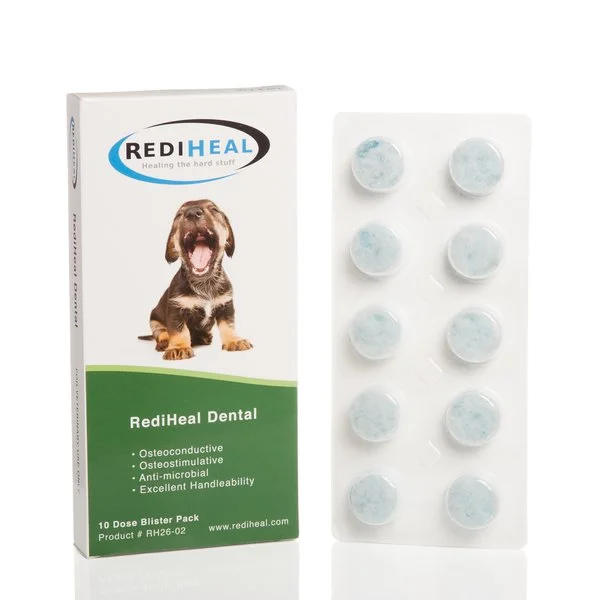
Watch extractions heal differently.
Faster healing. Stronger bone regrowth. Fewer complications. RediHeal Dental transforms routine extractions into confident, predictable outcomes — without complicated prep or guesswork.
Clean, Confident Healing — Ready When You Are
RediHeal Dental is a ready-to-use biological fiber that speeds healing and bone regeneration after extractions. Made from borate-based bioactive trace elements (not antibiotics or steroids), it actively promotes tissue regeneration, gently fills extraction voids, and reduces complications like fistulas or delayed healing.
Why Vets Choose It:
Speeds healing up to 50% faster
Promotes strong bone regrowth post-extraction
Prevents dry sockets and fistulas
Easy for staff to use — no prep, no mess
Use It For:
Extractions (large or small)
Periodontal procedures
Filling voids after trauma or surgery
What's Inside: 10 individually blister-packed pods, 0.45g each. One pod handles a large canine molar — cut in half or thirds for smaller teeth and save what's left for future cases.
Try It Risk-Free Not sure if it's right for your clinic? Try it. If you're not happy with the results, return what's left for a full refund.
For more studies, application techniques, and additional case documentation, visit the RediHeal Dental page.
Additional Resources

Our Distributors: